Career Navigator
Helping employees explore and pursue internal opportunities with confidence and clarity
Overview
Internal mobility is one of the biggest drivers of retention, yet only 1 in 3 employees look internally first when considering a new role. At Beamery, I led the design of Career Navigator, a tool that helps employees discover new opportunities within their company and take action with more confidence and clarity. The prototype I created became a key part of our go-to-market strategy and was used in sales conversations to help secure several large enterprise contracts.
Company: Beamery
Sector: HR Technology, B2B SaaS Platform
Role: Product Design, User Research
Timeline: June – November, 2023
Research and Insights
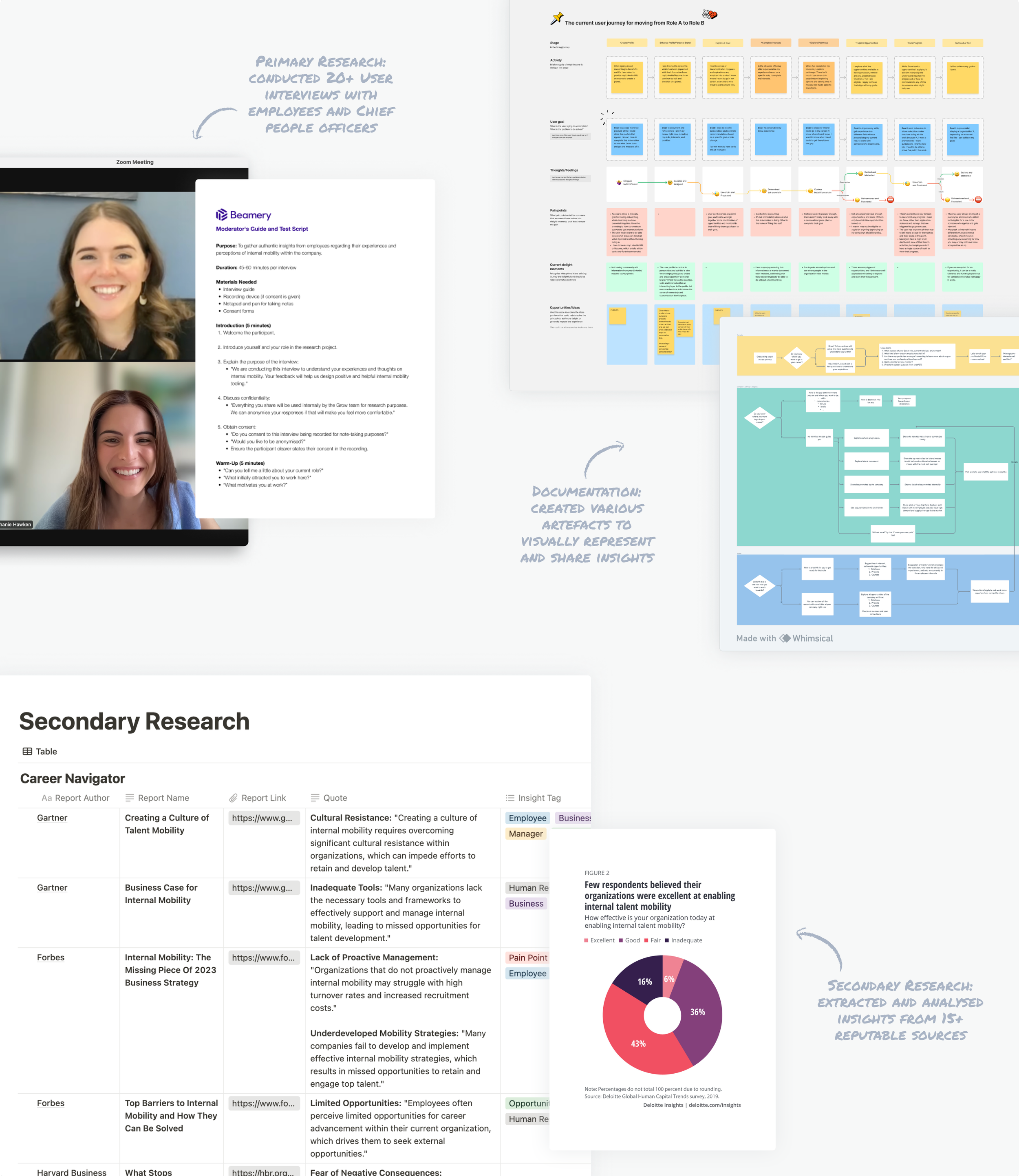
Together with Product Owner Richard Xi, I set out to understand why employees often overlook internal roles and what holds them back from making a move even when they’re ready for change. What we uncovered shaped several key product decisions and design priorities.
-
To understand why employees often pass over internal opportunities, and explore how open they are to using company-sponsored tooling to explore role changes.
-
To work around limited access to end users, we leveraged a creative, mixed-methods approach:
Personally interviewed 20 employees and 3 Chief People Officers across several industries
Validated patterns using secondary research from leading industry sources, including McKinsey (management consultancy), Harvard Business Review (business and leadership research), Gartner (technology and HR advisory), and LinkedIn Talent Insights (workforce data and trends).
Spoke with Beamery’s new hires about why they left their previous companies and what role internal mobility played in that decision. Because they were no longer tied to those organisations, they were able to speak openly and reflect more honestly on what worked and what didn’t.
This gave us a well-rounded view of the problem from both employee and leadership perspectives — even without direct access to end users inside client organisations.
-
Low visibility beyond their current team
Employees rarely saw roles outside their immediate domain, which limited their sense of possibility.
→ We prioritised a role discovery experience that surfaces opportunities across functions and locations.Fear of being seen as disloyal
Many worried that expressing career goals would put them at risk or damage relationships with their managers.
→ We designed a private, self-service experience that doesn’t require manager approval to explore roles.Mobility driven by who you know
Internal moves often relied on backchannel advocacy or personal connections, creating inequity.
→ We introduced a feature where employees can choose a trusted advocate — like a mentor or peer — once they’re ready to take action.Lack of direction despite high motivation
Employees wanted to grow but didn’t know how to close the gap between where they were and where they wanted to go.
→ We built in personalised guidance, including steps to close skill gaps aligned with specific roles.
Rapid Experimentation
My Role
I led the end-to-end design process — from early concept sketches and flow mapping to low- and mid-fidelity prototypes in Figma. I collaborated closely with Product, Engineering, and Customer Success to ensure feasibility, reusability of existing components, and alignment with go-to-market strategy.
Core Design Decisions
Compass-inspired interface: I introduced a non-linear, navigation-focused layout to reflect the exploratory nature of career development. This helped shift the tone from corporate and rigid to personal and empowering.
Private discovery and opt-in advocacy: Employees could browse roles, view potential matches, and take next steps without triggering a notification to their manager. When ready, they could invite a trusted mobility advocate to support their journey.
Guided growth paths: Each role included suggested next steps, skill-building resources, and insights into gaps to close. These nudges helped turn intent into action, especially for employees unsure how to advance.
Dual-perspective experience: While employees saw a personalised, safe space to explore, organisations gained high-level, anonymised data to track mobility patterns, skill trends, and retention risks.
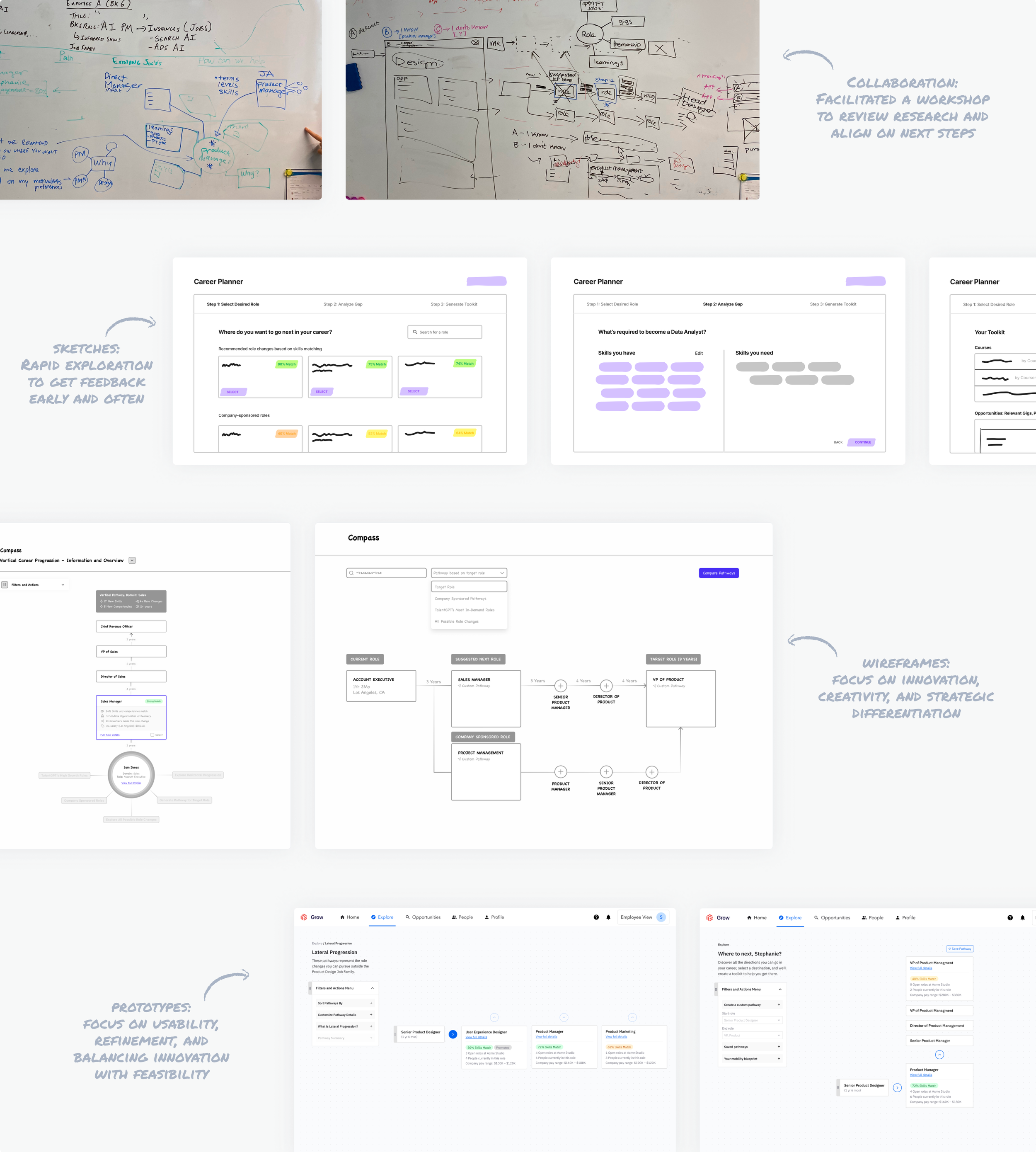
Validating Solutions
My Role
I led the design of a high-fidelity prototype of Career Navigator, featuring a compass-inspired layout to reflect the non-linear nature of career growth. I focused on refining interaction flows, content clarity, and accessibility, while working closely with engineering to align on feasibility.
Impact
The prototype tested well in usability sessions, with employees responding positively to the private, self-guided experience and clear growth pathways. It was also used in sales demos, where it played a key role in securing several new client contracts and renewals — demonstrating strong product-market fit and customer interest.

Impact and results
The final compass-inspired prototype became a highlight in sales demos, helping secure several high-value client contracts and reinforcing Beamery’s position as a leader in internal mobility. By introducing new interaction patterns and experimenting with AI-powered suggestions, the design pushed Beamery Grow in a more innovative, employee-first direction. It also helped senior leadership visualise a bold new product vision and gained strong cross-functional buy-in.